Fire should constantly burn on the altar, It shall not be extinguished. (Leviticus/Vayikra 6:6)
I once visited a Jewish secular school in Argentina. The program called for me to deliver a talk on Judaism and afterwards take questions from the audience. The principal of the school asked me repeatedly if in fact it was permitted to ask questions. His manner indicated that he was belittling religion, as if to say that religious people do not allow questions to be asked, but rather demanded belief with unquestioning blind faith, without reason. In his mind, the reason secular Jews do not observe mitzvos is because they consider themselves wise people who do things only when there are reasons which they can understand. Since they have questions about religion which they cannot fathom, they therefore refuse to do things based on blind faith alone.
I told the principal "Of course it is permitted to ask questions. Please ask any questions you have. On the contrary, Hashem wants us to ask questions and know the reasons, as it is written (Divrei HaYammim 1- 28:9/I Chronicles) "know the G-d of your father and serve Him", exhorting us to 'know' Hashem. He does not want us to remain with blind faith without knowing the reason. This is why on the holiday of Pesach the Seder begins with various changes from the usual in order to provoke questions from the children and provide them with answers, so they grow up knowing that there is an answer to every question. We speak about four types of children to demonstrate that are answers for each type of person, whether wise, or wicked, or simple, or even one unable to ask a question. We are obligated to teach and enlighten everyone. This all takes place at the very beginning of the Pesach festival, celebrating the commencement of our becoming the People of Hashem, to teach us that as People of Hashem we ask questions and receive answers.
The Holy Torah is greater than the Earth and wider than the Sea (Job 11-9/איוב יא-ט). Every question has many answers, and no individual knows everything. A simple doctor may lack an answer and must ask a professor. If the professor lacks an answer, he will ask someone more specialized who has spent many years to become an expert in the particular field of study. Everyone needs to ask someone more learned than he, or to find answers in books, as there is no question that has no answer. When we ask a medical question from a doctor, we first do what he tells us to do even before we have asked and understood his reasons. Hashem wants us to serve Him with Emunah/Faith even before we know the reasons, and subsequently when one studies diligently, one will ultimately find reasons.
Then, the above-mentioned principal asked the common question that secular Jews often ask "Where was G-d during the Holocaust if He is the guardian of Israel? I answered him with a parable; a father had his first and only son born when the father was advanced in years. He had incredible love for his only son. The father warned the little boy to avoid eating certain foods which would be life-threatening for him. However, the son did not heed his father's instructions and would eat those very foods his father warned him against. The boy became deathly ill and the doctor declared that the boy must have critical surgery or else he would die Rachmana letzlan! Obviously, the father insisted on the operation taking place. The son, not realizing his perilous state, cried and screamed that the father must hate him if he will let a doctor cut him up. He carried on about the 'bad' and 'vicious' father he had. It was not pleasant hearing his son call him disparaging names, but this did not prevent the father from ordering the surgery to save his son's life. The son was obviously ignorant of the life-saving benefit of the surgery, and the father had to do everything to save his life nonetheless.
Similarly, and even all the more so, the Creator is our merciful Father, Whose mercy and love are Infinite. He cautioned us to fulfill the mitzvos, as this is the purpose of the creation of man. He warned us that terrible punishment would result if we ignored His instructions. This is because Hashem must purify the body of sin, and humble the depraved instincts of human beings, to enable the soul to benefit eternal life. The primary part of the human is the soul, which is G-dly and is always attached to Hashem above. The soul lives both in this world and in the World to Come, as opposed to the body which is merely a garment for the soul in this world. Sometimes, even someone who has never committed a sin can receive suffering from Hashem, the faithful physician, to rectify some spiritual damage which was done to the soul in a previous reincarnation, or for other reasons (as explained in the holy sefer Be'er Mayim Chaim in Parshas Chukas).
The power of the faith that everything is from Heaven gave refugees from the Holocaust the encouragement they needed to be steadfast and remain on the path of Hashem. Through faith, they were able to rejoice in the most difficult situations. Even after the murders of their relatives they knew that Hashem is the One who causes death and revives life, and that had He chosen to do so He would have allowed them to remain alive, and what He did was also for the good. During the Holocaust, the great Tzaddik Rebbe Aharon of Belz ztvk"l was informed that his eldest son Rabbi Moshe HY"D was grabbed by some Nazis and burned alive in a bonfire. Upon hearing the tragic news the Rebbe said "Baruch Hashem! I Hashem deemed me worthy to also bring a sacrifice to Him!" I also heard that someone was describing to the Rebbe how he had suffered in the Holocaust, and then asked the Rebbe "didn't the Rebbe also suffer?" The Rebbe zt"l grabbed the man and said: "Take back your words! I never suffered!"
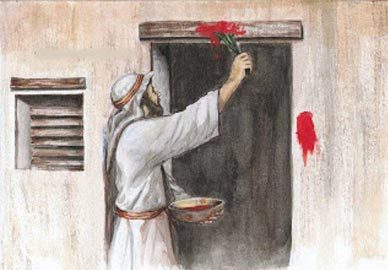
The Jews in Egypt possessed this Faith. Although they were cruely enslaved and oppressed, the fortified themselves with Emunah/Trust that everything was Heavenly ordained for their ultimate benefit. Therefore, when G-d then commanded them to slaughter a lamb (the Egyptian diety) for the Pesach offering the Jews didn't hesitate but rather ran with joy to carry out G-d's command at risk of their lives. G-d then commanded them to place some of the lamb's blood on the doorposts of their homes similar to blood of a sacrifice which is placed on the altar. The tremendous self-sacrifice of the Jews to do Hashem's will transformed their homes into altars of Hashem.
According to this, it is possible to say that this is hinted in the verse "ESh" (fire), which stands for "E'munah" and "S'imchah" (faith and joy) - "should constantly burn on the altar" - this spiritual fire will constantly burn in every faithful religious Jewish home, which is like the altar. "It shall not be extinguished" - even in difficult situations, faith and joy will not be extinguished, because they always know that everything the Merciful Lord does, He does for goodness and benefit.

No comments:
Post a Comment