Sunday, June 30, 2024

Fwd: Torat Imecha Halacha : Preparing for Shabbos


---------- Forwarded message ---------
From: OU Women's Initiative <ouwomen@ounetwork.org>
Date: Sun, Jun 30, 2024, 8:00 AM
Subject: Torat Imecha Halacha : Preparing for Shabbos
To: <agentemes4@gmail.com>


Torat Imecha Halacha

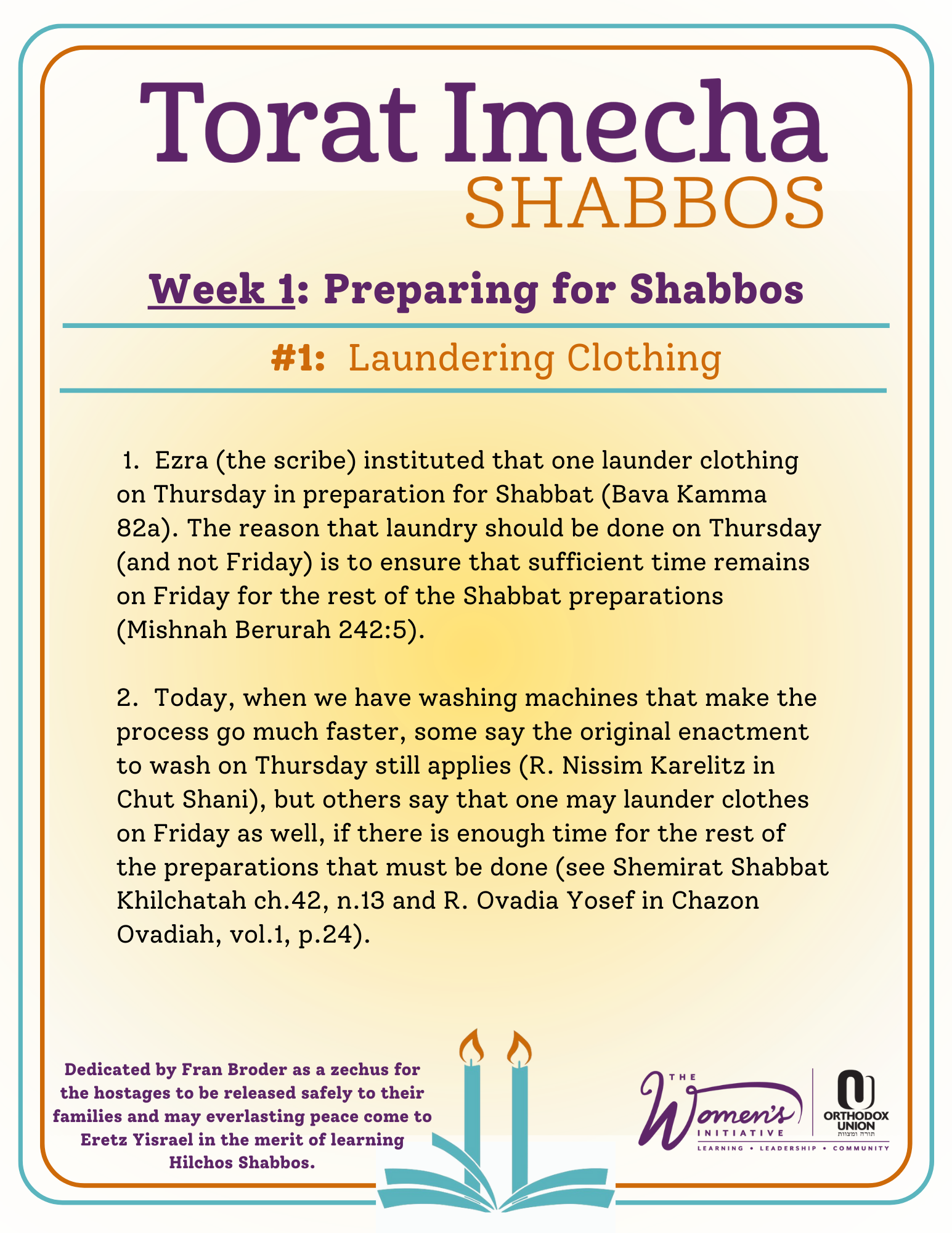
Welcome to Torat Imecha Halacha, a new project of the OU Women's Initiative. The series begins with Hilchos Shabbos.


We are so thrilled you are part of this journey to better understand and know the ins and outs of halacha, our daily Jewish living.You will receive one halacha post with two halachos a day Sunday through Thursday. On Fridays, you will receive a meaningful machshava piece, usually related to our halachic topic of the week.


We thank Rabbi Eli Ozarowski for his time and dedication in preparing the Torat Imecha Halacha series.


We thank our series sponsor, Fran Broder who has dedicated Torat Imecha Halacha as a zechus for the hostages to be released safely to their families and may everlasting peace come to Eretz Yisrael in the merit of learning Hilchos Shabbos.


Much continued Hatzlacha with your learning.


Halacha Introduction

Share this message on: Facebook | Twitter

40 Rector St, 4th Floor, New York, NY 10006

Unsubscribe | Forward | Privacy Policy

© 2023 Orthodox Union, All rights reserved.


Fwd: Weekly lesson in From Slavery to Redemption #19


---------- Forwarded message ---------
From: Torat Har Etzion <torat@haretzion.org.il>
Date: Sun, Jun 30, 2024, 1:01 AM
Subject: Weekly lesson in From Slavery to Redemption #19
To: agentemes4@gmail.com <agentemes4@gmail.com>


en_site_logo
Attached is the Weekly lesson in From Slavery to Redemption #19 entitled The Curious Incident at the Lodge (2): A Bridegroom of Blood. 

"And war will come in your land... and you will sound the trumpet and remember before the Lord your God." The Beit Midrash proceeds with strenuous and meaningful study, civil aid and volunteering - as well as prayers for the people of Israel in times of need. 

May we hear only good news. 
Weekly lesson in From Slavery to Redemption #19

The Curious Incident at the Lodge (2): A Bridegroom of Blood

Dr. Yael Ziegler         Tanakh


Circumcision and Covenant

In this shiur, we return to the curious incident at the lodge, where Tzippora deflects the danger of death by circumcising her son (Shemot 4:24-26). As noted in the previous shiur, the act of circumcision symbolizes membership in a nation that requires devotion to God's service, even when there are dangers.

In coercing Moses to circumcise his child as he moves toward his divine mission, God educates the nation as well. A midrash posits that after Joseph died, the Israelites stopped circumcising their sons in their desire to assimilate into Egypt.[1] Prior to exiting Egypt, they must undergo mass circumcision, a precarious act on the eve of their journey out of Egypt.

Israel does not seem to internalize this message of the importance of fulfilling the covenant of circumcision despite danger. The book of Yehoshua states that Israel did not circumcise the children born in the desert, presumably because of the dangers of the journey:[2]

And this is the manner in which Joshua did perform circumcision: All the people who came out of Egypt, that were males, all the men of war, died in the wilderness on the journey out of Egypt. For the nation left Egypt circumcised, but all the nation born in the desert on the journey out of Egypt had not been circumcised. For Israel walked in the desert for forty years, until the entire nation of warriors who left Egypt and did not listen to God's voice perished. But the sons whom [God] had raised up in their stead, Joshua circumcised, for they were uncircumcised, not having been circumcised on the journey. (Yehoshua 5:4-7)

Under normal circumstances, it is legitimate to delay circumcision in order to avert danger;[3] however, the above passage links their choice to a general refusal to listen to God! It therefore seems that the nation's laxity toward circumcision is part of their disobedience. Had Israel properly absorbed the lesson that God conveys to Moses on his way to Egypt, they would have valued circumcision enough to overlook the danger. However, the next generation, born and raised in the desert, will display the courage lacking in their parents. They will undergo circumcision immediately following their entrance into the land (Yehoshua 5:2-8). It is an act of great faith for the men to deliberately perform surgery on themselves on the eve of battle, in full view of the Canaanite enemy, and with the knowledge that this will physically weaken them.[4]

Circumcision is an assertion of identification with the covenant between the Israelite nation and God.[5] It is an act of courage, faith, and a strong desire for membership in Israel. At this point in the story, Moses may still be ambivalent about his child's identity, as well as his own. Perhaps for this reason Moses is not named during the incident: the infant whose naming seemed so significant in chapter two (2:10) has grown up; he now seems on the cusp of losing his identity, depending upon the outcome of this incident. Identity (and along with it, one's destiny) throughout this story is bestowed and restored by the women (as we noted in shiur #8), and it comes as no surprise that Tzippora delivers Moses from losing his name and his destiny.

Like the other women who have functioned in central roles to push forward the story of salvation, Tzippora acts as the heroine: the only person named and the only one who speaks.[6] By swiftly circumcising her son, she identifies him as a member of the nation of Israel, consecrating him to God and ameliorating the perilous situation.[7]

In a cryptic motion, Tzippora touches the foreskin (or the blood according to the Aramaic Targum) onto the legs of either Moses or the newly circumcised child.[8] Uttering a hardly comprehensible statement ("for you are a bridegroom of blood for me"), she pays special attention to the blood (of the circumcision, presumably).[9] This draws attention to the dangerous nature of the procedure, which draws blood.

Despite the danger, the incident at the lodge teaches that circumcision can function in a prophylactic role, protecting rather than harming. This lesson will serve Moses well later in the story, as Israel prepares for the plague of the firstborn and the Exodus from Egypt. To eat from the Paschal sacrifice (and use its blood to save the firstborn Israelites from the danger of death), Israel must be circumcised (12:48). Moses can learn from Tzippora (in advance of God's instructions in 12:13) that blood may be used to save the firstborn sons from the final plague that threatens all the firstborn children (12:12, 23).[10] A midrash posits that the blood daubed on the doorpost was a mixture of blood from the Paschal sacrifice and blood from the nation's circumcision.[11] In fact, the word used to portray Tzippora's act of touching the legs (va-taga, 4:25) reappears at the conclusion of the Exodus narrative. When Moses instructs Israel to apply the blood of the Paschal sacrifice on their doorposts to protect the Hebrew firstborn, he uses the word ve-higatem ("and you shall touch," 12:22).[12] The Exodus story is framed by two acts of daubing blood, establishing a "sign" designed to protect a firstborn child from danger posed by God.[13]

But why is circumcision not sufficient to protect the firstborn child from God's plague? Why is there a need to smear the blood of the Paschal sacrifice on the houses?

The commandment of circumcision shares some unique features with the Paschal sacrifice. They are the only positive commandments that incur the punishment of karet, an abstract concept that penalizes a transgressor by severing his ties with his nation.[14] To receive this harsh penalty, one generally must willfully transgress a grave negative commandment, declaring by one's actions a disdain for communal norms. Abstaining from positive commandments suggests laziness and is not usually considered a serious enough infraction to warrant karet. However, both circumcision and the Paschal sacrifice are exceptions to this rule. Refusal to partake of either of these commandments indicates that one has opted out of the covenant and deserves to be cut off (karet).[15]

Circumcision appears to symbolize the entrance of an individual into the covenant between God and Israel, while the Paschal sacrifice represents entrance into a covenantal community.[16] These two commandments are intertwined, [17] together representing a process of admission into the covenantal community.[18] The story of the Exodus is launched with an act of circumcision done by an individual (Tzippora). By the end of this narrative, the act of circumcision is a communal act, illustrating that a nation has come into existence, one devoted to service of God.[19]

Firstborn and First Fruits

I will conclude this shiur with one final thought, related to the significance of the firstborn. The "firsts" of everything must be consecrated to God, in recognition and appreciation of God as the prime benefactor of everything: fruits, wheat, animals, and sons. All of Israel is called a firstborn (4:22), and therefore all of Israel is dedicated to God's service.

Pharaoh's refusal to accept God's authority denies this notion; God strikes at the firstborns of Egypt to remind them that everything truly belongs to Him. Possibly, Moses' fivefold refusal (in 3:1-4:17) to dedicate himself in service to God provokes a similar reaction, with a similar message.

Immediately following the laws of circumcision (12:43-50), God informs Moses that all firstborns – humans and animals – must be consecrated to Him (13:2).[20] Thus, the Exodus concludes with both circumcision and the dedication of the firstborn, two acts that showcase Israel's commitment to the covenant and to serving God.


We pause our series, for the time being, as Moses is on his way to Egypt. When we return from summer break, we will explore what transpires once Moshe arrives in Egypt. I wish you and your families a good and healthy summer, filled with Torah, nachat, and kindness, and I conclude with tefillot that Hashem will help our soldiers with success and safety, that the captives will return home, that the wounded will have a full recovery, and that Am Yisrael will receive besorot tovot, yeshuot, and nechamot.


[1] Shemot Rabba 1:8; Tanchuma Shemot 5. This midrash is supported by God's proclamation following the nation's circumcision as they enter the land: "Today I have rolled away the shame of Egypt from upon you" (Yehoshua 5:9). Despite this verse, there is an ongoing debate among scholars as to whether ancient Egyptians practiced circumcision.

[2] Note that the word ba-derekh ("on the way") appears three times in Yehoshua 5:4, 5, 7, and also appears in Shemot 4:24. Another word that connects these incidents is zor, referring to the flintstone used to circumcise (Shemot 4:25 and Yehoshua 5:2-3.)

[3] The halakhic practice is clear about this – circumcision does not take place if it will endanger the child. This is based upon the Mishna in Shabbat 19:5, which states that one does not circumcise a sick child.

[4] The crossing of the Jordan River represents the birth of the nation, which is followed by a mass circumcision. The triumphant conclusion of the Exodus also involves a symbolic birth – yet, as noted above, the crossing of the Reed Sea is not followed by mass circumcision, an omission that suggests a religious failure.

[5] That is why the punishment for failure to circumcise is karet, being cut off from the nation, as we will shortly discuss.

[6] Tzippora's act is especially surprising given that the commandment of circumcision devolves upon the father and not the mother (see the discussion in AvodaZara 27a).

[7] Targum Onkelos (Shemot 2:26) explicitly notes that Tzippora's act saved Moses: "Were it not for the blood of this circumcision, my husband would have been condemned to death."

[8] YerushalmiNedarim 3:9 records a debate on this matter, including a third possibility – that this refers to the legs of the angel (although there is no angel mentioned, presumably this is a reference to a divine agent that God sends to kill him). Rashi and Rashbam both assume that Tzippora smears the blood on the legs of Moses. This draws attention to Moses' legs, perhaps as a criticism for his previous slothfulness toward his journey, or possibly as a consecration of his legs, which will now move him inexorably toward the fulfillment of his divine mission. Chizkuni raises the possibility that the word "legs" here refers to the genitals, in keeping with the circumcision theme (see my discussion on this euphemism in Ziegler, Ruth, 295, fn. 12).

[9] Exegetes scramble to try to understand Tzippora's two utterances. I will offer a few representative explanations, without attempting to be comprehensive. Tzippora's first utterance is directed to someone in a second-person address. Rashi claims that she spoke these words to the child, accusing the child of almost causing her husband's death: "You are the death-bringer to my husband!" After Moses is saved, she understands why his life was threatened, producing her second, explanatory utterance (4:26): "My husband would have been killed because of circumcision!" Onkelos explains the first utterance in a more positive manner: "By this blood of circumcision, my husband is given to me." See similarly ShemotRabba 5:8. The Septuagint appears to translate a markedly different phrase: "I have staunched the blood of my child's circumcision." Perhaps, however, Tzippora addresses this utterance to the child, declaring that he is a chatan of blood to her. In this schema, some suggest that the word chatan relates to a cognate word in Arabic that refers to a recently circumcised child as a chatan (see BDB, p. 368). Possibly, this is related to the meaning of the word chatan as "protect," which may derive from the idea that a circumcised child receives some divine protection.

[10] Once again, we see Moses learning from the women in his life how to function effectively as a leader: just as he learned compassion, courage, and protectiveness from his biological mother, his sister, and his adopted mother, during this episode he learns from Tzippora how to implement the lessons of circumcision.

[11] ShemotRabba 17:3; Targum Pesudo-Jonathan Shemot 12:13. The midrash explains the twofold reference to blood in Yechezkel's portrayal of Israel's birth: "And I passed over you and I saw you rolling in your blood. And I said to you, 'With your blood you shall live!' And I said to you, 'With your blood you shall live!'" (Yechezkel 16:6). Some scholars suggest that the reason Tzippora understands what to do is because she – as a woman who has experienced childbirth – understands that blood and physical danger can lead not just to death, but to birth and life. Indeed, Israel's national birth is launched by two mitzvot of blood (circumcision and the Paschal sacrifice) that give life.

[12] See Ibn Ezra on Shemot 4:25; 12:7.

[13] The word ot (sign) describes both circumcision (Bereishit 17:11) and the blood applied to the houses (Shemot 12:13).

[14] Mishna Keritot 1:1. See Bereishit 17:14, which states that the person who refuses to circumcise will be cut off from his nation.

[15] The text may hint to this idea by using an unusual term (va-tikhrot) – the same root as karet (cutting off) – to describe Tzippora cutting the child's foreskin. The usual verb for circumcision would be mul (e.g., Bereishit 17:23; Yehoshua 5:3).

[16] Women are obligated to participate in the Paschal sacrifice (Pesachim 79b), but not in the commandment of circumcision. While this issue is beyond the scope of our shiur, it is worth noting that according to one opinion in Avoda Zara 27a, this is because a woman is considered to be naturally circumcised. Perhaps, according to this view, all that is accomplished by circumcision is already present in women.

[17] Significantly, these are the two mitzvot performed by Israel upon entrance to the land of Israel (Yehoshua 5:3, 10), marking the moment with acts that symbolize commitment to the covenant as individuals and as a community.

[18] This can explain why an individual who has not been circumcised cannot eat from the Paschal sacrifice (Shemot 12:48). See Rambam, Hilkhot KorbanPesach 4:4-5. Rabbinic sources debate whether a child who is uncircumcised for legitimate reasons (such as a medical condition that caused his brother's death after circumcision) may eat the korban pesach. Rashi (Pesachim 60a) maintains that the uncircumcised person still may not eat the from the communal sacrifice. Tosafot (Chagiga 4b) disagrees, asserting that this is only the case if the individual deliberately avoids circumcision.

[19] Perhaps this is why Mekhilta Bo 5 explains that the performance of these two commands enable Israel to obtain the merits necessary for divine redemption.

[20] Exegetes tend to read this in the opposite direction. The commandment of consecration of the firstborn is a result of the plague of the firstborn. See, e.g., Rashi, Ibn Ezra, Ramban, Ralbag, Shadal, Bekhor Shor on Shemot 13:2. This approach is supported by Shemot 13:15; Bamidbar 3:13; 8:17. The two approaches are not necessarily mutually exclusive. It is possible that Pharaoh's rejection of the idea that underlies the consecration of the firstborn (recognition that all comes from God and therefore the first of everything must be consecrated to God) produces the plague of the firstborn. The idea that emerges from that plague is concretized in a formal commandment to consecrate all firstborns to God.


Did you miss a lesson or two?
Remember: At the bottom of each lesson on the site
You can easily access all previous lessons in the series.
yemei_iyun_5...
____________...
564_________1
__Yagdil_Tor...
לחץ לקבלת לגרסה הנגישה
Har Etzion Institutions Yeshiva 1 | Alon Shvut Israel | 02-9937300

נשלח באמצעות תוכנת ActiveTrail

Saturday, June 29, 2024

Fw: [-aneinu] Updated Injured List


----- Forwarded Message -----
From: "'Chicago Aneinu' via chicago-aneinu" <chicago-aneinu@googlegroups.com>
To: "Chaya Miriam Wolper" <myysbyy@aol.com>
Cc:
Sent: Sat, Jun 29, 2024 at 11:34 PM
Subject: [chicago-aneinu] Updated Injured List
Gut Voch,
I have added Menachem Dovid ben Miriam, a soldier who was seriously wounded in Gaza
His friends have asked for tefillos on his behalf.


May Hashem bless all of our injured with a speedy refuah shlema.


Many of the hostages in captivity have injuries or illnesses. As you daven for them, please include a request for their refuah shlema.

Hostage List:

May Hashem please bring all of the hostages home NOW!

Imprisoned in Moldova
Nosson Peretz ben Tamar 

Imprisoned in Iran
Arvin Netanel ben Sonia 

Kerem Shalom Missile Attack 5/5/24
Avraham Mordechai ben Yael

Alei Siach Fire 4/14/24
Shlomo Chaim ben Leah
Yoel Moshe ben Udel
Yehonason ben Shifra Sarah
Eytan ben Yehudis
Elchonon ben Rivka 

Gan Yavne Terror Attack 3/31/24
Ben ben Rina
Roi ben Natalie

Neve Yaakov Terror Attack 3/6/24
Tzvi ben Dina

Switzerland Terror Attack 3/2/24
Meir Tzvi ben Sarah

Ma'ale Adumim Terror Attack 2/22/24
Chanania Yosef ben Tova 

Kiyrat Malakhi Terror Attack 2/16/24
Moshe Natan ben Henia Guita

Raanana Terror Attack 1/15/24
Nadav Ephraim ben Shulamit Leah (14 years old)

Yerushalayim Terror Attack 11/30/23
Avidan Moshe ben Mina Rivka (Shfeiner) Dayan at the Be'er Sheva Bet Din
Roi ben Michal (soldier)
Shoshana Bracha bas Rivka Yehudis  (Shafier nee Dekoven) is a former Chicagoan (released from hospital 12/25/23)

Civilians Injured in Swords of Iron War 10/27/23
Amichai ben Sigalit Rachel  (Shindler) (injured in safe room while protecting his family)
Chanina ben Tzofit (A Shepherd)
Maya bas Mirit (injured on Oct 7) released hostage
Mia bat Keren (Schem) released hostage

Soldiers/Policemen/ZAKA/Hatzalah Injured in Swords of Iron War 10/10/23

Achiya ben Yael Chaya 6/15/24
Adam ben Lydia 3/9/24
Aden ben Chana 6/23/24
Aharon ben Sora Hendel  5/22/24 (Aharon Sternlib)
Akiva Shalom ben Dvora Chana 5/18/24
Almog ben Shinhav  
Alon ben Idit Tova 
Alon ben Ina 5/5/24 (seriously wounded)
Amit ben Bella 5/5/24 (seriously wounded)
Amit ben Michal
Amit ben Shinhav - 3/29/24 (badly injured in building bombing/collapse)
Amit Yosef ben Devira - 3/29/24 (badly injured in building bombing/collapse)
Amos ben Yolanda 3/9/24
Ariel ben Efrat 2/27/24
Aryeh Eitam ben Ra'aya - 3/29/24 (badly injured in building bombing/collapse)
Aviad ben Liat - 3/29/24 (badly injured in building bombing/collapse)
Aviad Chaim ben Noa 5/5/24 (seriously wounded)
Avishai ben Miriam 12/19/23 (injured in leg)
Avraham Michael ben Esther 5/5/24 (seriously wounded)
Avraham Yagel ben Na'ama 5/17/24
Avraham Yosef ben Shayna Esther 5/17/24
Ayal ben Penina 12/26/23 (critical)
Ayal ben Rachel 3/29/24
Ayil David ben ltal 4/9/24 (seriously injured)
Barel ben Hila 5/29/24
Baruch Boris ben Irena  11/21/23 (critical)
Ben ben Netiva  12/19/23 (critically injured, head injury, hand was amputated, doctors are battling to save his other hand)
Ben Yosef ben Tzipora
Binyomin Yitzchak ben Sara 5/5/24 (seriously wounded)
Chaggai Naftali ben Esther Avigail (critical) 11/2/23
Chai Ben Zion Yehuda ben Adina
Chaim ben Miriam 2/27/24
Chaim ben Osnat  6/21/24
Chaim Yiron ben Shoshana 3/9/24
Chananya Shalom ben Ilana Nava 3/29/24
Chanoch ben Gila 1/14/24 (serious)
Chen Chana bas Kochava 3/9/24
Danny ben Chava 
Dolev Ben Tamar
Don ben Hava 6/15/24
Dovid ben Nurit 6/15/24
Dovid ben Ziva 12/26/23 (critical)
Dovid Elimelech ben Chana 3/29/24
Dovid ben Elisheva 4/17/24 (badly wounded) (he has a brother who was wounded previously in this war)
Dvir ben Granit (critical) 10/31/23
Dvir ben Leah 12/19/23 (gravely injured in legs)
Eden ben Vered 12/30/23 (ramming attack near Chevron)
Eitam Ravid ben Noga - 3/29/24 (badly injured in building bombing/collapse)
Eitan ben Sara 12/19/23 (grave leg injury)
Eitan Yitzchak ben Edna 6/15/24
Elam Ben Efrat
Eli ben Chagit 5/13/24
Elia ben Merav
Elimelech ben Vabit 5/22/24
Eliran Yitzchak Mordechai ben Patricia Ahuva 5/18/24
Elisha ben Ilanit 5/29/24
Elkanah Yitzhak ben Ronit 5/29/24
Elroee Yanon ben Sigal 2/27/24
Elyakum ben Devora 5/17/24
Eran ben Batsheva 12/19/23 (grave leg injury)
Erez ben Shoshana 3/9/24
Evyatar ben Natalie 10/24/23
Eyal ben Mona 1/23/24 (severe injury - eye)
Eyal ben Rachel
Gai ben Ayala 6/15/24
Gal ben Alima 5/18/24
Gal ben Chedva 12/21/23 (grave injury from massive shrapnel in jaw)
Gal ben Iris 5/18/24
Gavriel ben Rivka 6/21/24
Gilad Itay (Ee-tie) ben Efrat 12/11/23 (bullet & shrapnel in his head)
Guy ben Milka
Hadar Chaya bas Malka 3/9/24
Haim Ben Mira
Hanania Shalom ben Alina Nava
Har'el ben Tamar 6/21/24
Harel ben Chana 5/29/24
Harel Chaim ben Miriam 1/3/24 (seriously injured)
Hoji ben Chava 5/29/24
Idan ben Tova 1/8/24 ( BH improved, out of coma) Idan Amedi
Ido ben Ilanit 3/9/24
Ido ben Inbal Rochel 1/14/24 (critically wounded in the head in a coma)
Ido ben Niva 3/1/24
Ido ben Simona 4/7/24
Igor ben Inna 11/22/23
Ilai ben Shireli 3/9/24
Ilai Daniel ben Maayan 3/1/24
Ili ben Chagit 5/18/24
Ili ben Irit 6/15/24
Itai ben Adi
Itai ben Ilana 5/18/24
Itai Avraham ben Rachel 5/18/24  
Itai ben Lilach 6/10/24
Itai ben Marina 12/21/23 ( do not know extent of injuries )
Itai ben Rinat 12/19/23 (intermediate level stomach injury)
Itai ben Rochel 2/27/24
Itamar ben Devora 6/15/24
Itamar ben Gitit 5/5/24 (seriously wounded)
Itamar ben Noa 5/29/24
Itamar Mordechai ben Illit 5/29/24
Itay ben Nurit
Iti ben Rachel
Iya ben Ravit 5/5/24 (seriously wounded)
Lev ben Yelena 6/21/24
Levi ben Irit
Lial ben Chana 3/9/24
Lial Hoshea ben Miriam 12/21/23 (critical head injury)
Liam Ben Anat
Lidor ben Meirav 5/18/24
Liel (kabda) ben Keren 6/15/24
Lior ben Mazal 12/19/23 (injured by shrapnel in leg)
Malachi ben Galit 6/21/24
Maoz ben Varda Devorah 4/1/24 (very critical condition)
Matan ben Dafna 11/19/23
Matan ben Michal 12/25/23 (both legs amputated)
Maxim ben Olga 12/19/23 (light injury in leg, undergoing surgery to remove shrapnel)
Menachem Mendel ben Devorah Rus 1/24/24 (critical)
Menachem Mendel ben Raizel Perel 10/20/23 (seriously wounded)
Menachem Nehora-ee ben Chava 3/9/24
Michoel ben Koren 5/28/24
Mor Mordechai ben Orna 12/21/23 (critical leg injury)
Moshe ben Chana Malka 12/19/23 (hand amputated)
Moshe ben Dalia 5/29/24
Moshe ben Dina 12/19/23 (arm injury)
Moshe ben Karen 3/15/24 (bullet in the head)
Moshe ben Rachel
Moshe ben Sigalit (Moshe Weitzman) Hatzalah
Moshe Aharon ben Leah Bayla 2/27/24 (great nephew of Murray and Lisa Goldenhersh, former Chicagoans)
Moshe Natan ben Haniya Gita
Nachshon ben Malka Bracha 5/23/24
Nadav ben Daniela 3/9/24
Nadav ben Esther Michal 3/9/24
Nadav ben Hila 1/24/24 (critical)
Nadav Ben Michal
Natan ben Rina 5/29/24
Natan David ben Dafna 1/24/24 (critical)
Natanel ben Fanny 12/19/23 (gravely injured)
Natanel ben Naava 12/19/23 (intermediate level knee injury from shrapnel)
Natanel Moshe ben Yocheved (critical) 11/9/23 
Nataniel Ben Anat
Nava ben Irit 3/9/24
Nava Avraham ben Tamara 6/15/24
Nechemia Shalom Dov Ber ben Arlene - intermediate level by shrapnel in eye and burns on face. son of a chabad shliach in alon moreh)
Neriya ben Rivka 12/19/23 (grave head injury)
Netanel ben Anat 3/9/24
Netanel ben Mitar 5/17/24
Netanel ben Necharat 1/14/24 (serious)
Nir ben Orna 10/28/23 (critical)
Nir Dovid ben Tsiviya 6/21/24
Nir Gutman ben Miriam 4/16/24 (from the Shaldag Unit - seriously wounded)
Niv ben Dina 3/9/24
Noam ben Aliza 12/19/23 (foot amputated, trying to save 2nd leg)
Noam ben Odelia 5/18/24
Noam ben Orna
Oded Ephraim ben Vivian 2/17/24 (critically wounded in vehicular accident)
Ofek ben Ro'ee 11/26/23 (critical)
Ofek Eliyahu ben Zahava 3/9/24
Ofer "Shrah-ya" ben Nava 11/27/23 (critical)
Ofir ben Yaffa 10/15/23 (police officer) (critical)
Ohad ben Bracha 12/19/23 (intermediate level face injury)
Ohad ben Devorah
Ohad ben Einav - 3/29/24 (badly injured in building bombing/collapse) 
Ohr Moshe ben Aliza 11/7/23 (woke up when he heard his daughter's voice)
Omer ben Michal - 3/29/24 (badly injured in building bombing/collapse)
Omar ben Tali 2/9/24 (Please daven that they don't need to amputate his leg)
Omer Aharon ben Sara 5/18/24
Omri ben Ayelet - 3/29/24 (badly injured in building bombing/collapse)
Or ben Rachel 12/19/23 (intermediate level injury)
Oren ben Ilana 12/19/23 (gravely injured in shoulder and arm, fingers amputated)
Ori ben Irit 5/5/24 (seriously wounded)
Ori ben Yael 3/29/24
Ovadiah ben Einav Leora - 3/29/24 (badly injured in building bombing/collapse)
Oz Baruch ben Rivka 1/4/24 (critical)
Oz ben Tamar 2/27/24
Oz Ezra ben Limor 5/23/24
Oz Moshe ben Tamar
Pinchas Yair ben Yocheved 12/19/23 (chest injury)
Ran ben Merel 12/19/23 (chest injury)
Raphael ben Dina 12/19/23 (Critically injured)
Refael ben Avital  5/18/24
Rif ben Ettie - 3/29/24 (badly injured in building bombing/collapse)
Ro'ee ben Louise 5/29/24
Roi'ee ben Liat  5/18/24
Rom Uri ben Mittal 5/29/24
Ron ben Avishag 5/29/24
Ron ben Bilha 12/19/23 (intermediate level injury)
Ron ben Chavatzelet 12/19/23 (critically injured by shrapnel all over his body)
Ron ben Ilana 5/29/24
Ronen Chai ben Leah 12/19/23 (critically injured)
Rotem ben Leah 12/19/23 (intermediate level injury)
Rotem ben Shagit 5/5/24 (seriously wounded)
Sa'ar Ben Limor
Sagi ben Osnat 12/19/23 (lightly injured by shrapnel in leg)
Sagiv ben Chava 5/18/24
Shachar Yaacov ben Devora 5/19/24
Shalom ben Galia 11/21/23
Shigav ben Yafit 5/18/24
Shilo ben Tirza 5/18/24
Shimon Pinchas ben Rivka 11/13/23 (critical)
Shlomo Ehud ben Juliet
Tal Gershon ben Sara
Tomer ben Tzipora 5/29/24
Tomer David ben Osnat 5/18/24
Ulieel ben Penina 11/27/23 (critical)
Uri ben Leora - 3/29/24 (badly injured in building bombing/collapse)
Uriel Menachem ben Ronit 6/15/24
Uriya Yosef ben Bat Chen 5/19/24
Yair ben Drora (cousin of Chicago Aneinu member)
Yair ben Naomi Esther 2/27/24
Yair Yedidya ben Milcha Bina 11/27/23 (critical)
Yam ben Liz 1/24/24 (critical)
Yaniv ben Rachel
Yanon ben Sigal
Yanon Shalom ben Sara 2/22/24 (serious condition)
Yaod Ido ben Frieda Rivka 12/19/23
Yarden ben Rachel
Yedidya ben Ayala 6/21/24
Yehonason Andrei ben Ariella 4/21/24 (severely wounded)
Yehonasan Chaim ben Tamar Miriam 1/2/24 (badly injured) brother killed 6 years ago
Yehonatan ben Miriam 5/18/24
Yehuda Aryeh ben Idit 5/17/24
Yeshua ben Chana 5/18/24
Yinon ben Ami 2/12/24
Yinon ben Sigal 3/29/24
Yitzchak ben Naava 12/19/23 (intermediate level shoulder injury)
Yitzhak Hai ben Muriel Odet
Yizgeni ben Elizabeth 12/19/23 (leg injury)
Yoav ben Yedida 11/27/23 (critical)
Yoaav ben Erika Esther 4/2/24 (serious condition, sedated and on a ventilator)
Yoav Shmuel ben Shlomit Anita 5/26/24
Yona Betzalel ben Chava Shoshana 10/11/23 (head wound/arm amputated)
Yonatan ben Chemda 12/21/23 (Do not know extent of injuries) 
Yonatan ben Yocheved 1/1/24 (seriously injured)
Yosef ben Efrat 1/3/24 
Yosef ben Oshera
Yosef Avichai ben Chana 5/12/24
Yosef Chaim ben Esther 12/19/23
Yosef Chaim ben Michal 2/13/24
Yosef Chaim ben Yael
Yosef Chaim ben Ziva12/19/23 (gravely injured along left side)
Yossef Ro'eey ben Chana 10/20/23 (seriously wounded)
Yotam ben Zehava 2/27/24


Chevron Shooting Attack 8/21/23
Aryeh Leib ben Ella

Terror Attack at Eli Junction Route 60 - 06/20/23
Eyran ben Naama
Uri ben Smadar
Moise ben Helena
Matanya ben Tirtza

Ramming in Shomron 11/22/22
Hadar bas Shani Shoshana

Operation Shield & Arrow 5/11/23
Shoshana Hadassah bat Ronit Rachel
 
Negev Region Car Accident 4/26/23
Ayala Molly Bat Nechama
Ilya Yinon Shraga Ben Baya Yardena
Netta Avraham Ben Ayala Molly
Shachar Yisrael ben Ayala Molly
Uri Amidan Ben Ayala Molly
 
Agrippas Street Terror Attack 4/24/23
David ben Sultana
 
Yom Hazikaron Terror Attack 4/25/23
Mordechai Dovid ben Ahuva Tikva
 
Shimon HaTzaddik Terror Attack 4/18/23
Moshe Yosef ben Malka
Yaakov ben Penina

Kiryat Arba Terror Attack Nov. 2022
Tamar bas Nira

Dizengoff St. Terror Attack 3/9/2023
Rotem ben Chava

Neve Yaakov Terror Attack 1/27/23
Matan Michoel ben Sara
 
Ariel Terror Attack
Idor ben Chaya Aviva
David ben Sarit Chaya

 
Shamgar Bus Accident
Batsheva bas Sora Chaya (married 6 months)      

 
Givat Zev Injured (Bleachers collapse)
Dovid Tzvi ben Liba
Shmuel Meir ben Zelda
Yaakov ben Gittel
Yehoshua ben Devorah
Yom-Tov Simcha ben Chaya Yehudis
 
Injured in Meron
Elazar ben Re-u-ma
Yosef Ezriel ben Chaya Michal 
 
Injured in Israel War/Terror Attack
Benayah Yisroel ben Aviva
Elad ben Julia 
Shalev Ben Revital  
פרק 6/ו
(א) לַמְנַצֵּחַ בִּנְגִינוֹת עַל הַשְּׁמִינִית מִזְמוֹר לְדָוִד:
 (ב) ה' אַל בְּאַפְּךָ תוֹכִיחֵנִי וְאַל בַּחֲמָתְךָ תְיַסְּרֵנִי:
 (ג) חָנֵּנִי ה' כִּי אֻמְלַל אָנִי רְפָאֵנִי ה' כִּי נִבְהֲלוּ עֲצָמָי:
 (ד) וְנַפְשִׁי נִבְהֲלָה מְאֹד וְאַתָּה ה' עַד מָתָי:
 (ה) שׁוּבָה ה' חַלְּצָה נַפְשִׁי הוֹשִׁיעֵנִי לְמַעַן חַסְדֶּךָ:
 (ו) כִּי אֵין בַּמָּוֶת זִכְרֶךָ בִּשְׁאוֹל מִי יוֹדֶה לָּךְ:
 (ז) יָגַעְתִּי בְּאַנְחָתִי אַשְׂחֶה בְכָל לַיְלָה מִטָּתִי בְּדִמְעָתִי עַרְשִׂי אַמְסֶה:
(ח) עָשְׁשָׁה מִכַּעַס עֵינִי עָתְקָה בְּכָל צוֹרְרָי:
 (ט) סוּרוּ מִמֶּנִּי כָּל פֹּעֲלֵי אָוֶן כִּי שָׁמַע ה' קוֹל בִּכְיִי:
 (י) שָׁמַע ה' תְּחִנָּתִי ה' תְּפִלָּתִי יִקָּח:
 (יא) יֵבֹשׁוּ וְיִבָּהֲלוּ מְאֹד כָּל אֹיְבָי יָשֻׁבוּ יֵבֹשׁוּ רָגַע:

1) For the musician, with musical accompaniment on the sheminis instrument, a mizmor by David. (2) Hashem, don't rebuke me in Your anger. Don't chastise me in Your rage. (3) Grant me Your mercy, Hashem, for I have been cut down. (4) Heal me, Hashem, for my bones shake with terror. My soul is utterly terrified, and You Hashem — How long? (5) Turn back, Hashem, release my soul. Save me as befits Your kindness ... (6) for there is no mention of You in death. In the grave who will thank You? (7) I am exhausted from groaning; every night my bed is drenched; with my tears I soil the place where I have lain.  (8) My eye is dimmed from anger, aged by all my tormentors. (9) Depart from me all wrongdoers, for Hashem has heard the sound of my weeping. (10) Hashem has heard my plea; Hashem will accept my prayer. (11) They will be ashamed and will be utterly astounded. When all my enemies return, they will be ashamed for a while.
 פרק 20/כ         
(א) לַמְנַצֵּחַ מִזְמוֹר לְדָוִד:
 (ב) יַעַנְךָ ה' בְּיוֹם צָרָה יְשַׂגֶּבְךָ שֵׁם אֱלֹקֵי יַעֲקֹב:
 (ג) יִשְׁלַח עֶזְרְךָ מִקֹּדֶשׁ וּמִצִּיּוֹן יִסְעָדֶךָּ:
 (ד) יִזְכֹּר כָּל מִנְחֹתֶךָ וְעוֹלָתְךָ יְדַשְּׁנֶה סֶלָה:
 (ה) יִתֶּן לְךָ כִלְבָבֶךָ וְכָל עֲצָתְךָ יְמַלֵּא:
 (ו) נְרַנְּנָה בִּישׁוּעָתֶךָ וּבְשֵׁם אֱלֹקֵינוּ נִדְגֹּל, יְמַלֵּא ה' כָּל מִשְׁאֲלוֹתֶיךָ:
(ז) עַתָּה יָדַעְתִּי כִּי הוֹשִׁיעַ ה' מְשִׁיחוֹ יַעֲנֵהוּ מִשְּׁמֵי קָדְשׁוֹ בִּגְבֻרוֹת יֵשַׁע יְמִינוֹ:
 (ח) אֵלֶּה בָרֶכֶב וְאֵלֶּה בַסּוּסִים וַאֲנַחְנוּ בְּשֵׁם ה' אֱלֹהֵינוּ נַזְכִּיר:
 (ט) הֵמָּה כָּרְעוּ וְנָפָלוּ וַאֲנַחְנוּ קַּמְנוּ וַנִּתְעוֹדָד:
  (י) ה' הוֹשִׁיעָה הַמֶּלֶךְ יַעֲנֵנוּ בְיוֹם קָרְאֵנוּ: 

(1) For the musician, a mizmor by David. (2) May Hashem answer you on the day of distress. May the Name of Yaakov's G-d protect you. (3) May He send your help from the Mikdash; may He support you from Tzion. (4) May He give consideration to all your minchah-offerings. May He accept your olah-offerings, Selah. (5) May He grant you according to your heart. May He fulfill your every plan. (6) We will sing joyously because of your deliverance, and we will gather around banners in the Name of our G-d. May Hashem fulfill all your requests.  (7) Now I know that Hashem continues to save His anointed one. He will continue to answer from His holy heaven, with the mighty victories of His right hand. (8) Some [depend] on chariots, and some on horses. We call out the Name of Hashem, our G-d. (9) They slumped and fell, but we stood up and were empowered. (10) Hashem save! May the King answer us on the day we call.
 
Psalms Chapter 130 תְּהִלִּים
א  שִׁיר הַמַּעֲלוֹת:
מִמַּעֲמַקִּים קְרָאתִיךָ    יְהוָה.
      1 A Song of Ascents. 
       Out of the depths have I called Thee, O LORD.
ב  אֲדֹנָי,    שִׁמְעָה בְקוֹלִי:
  תִּהְיֶינָה אָזְנֶיךָקַשֻּׁבוֹת--    לְקוֹלתַּחֲנוּנָי.
      2 Lord, hearken unto my voice; 
       let Thine ears be attentive to the voice of my supplications.
ג  אִם-עֲוֺנוֹת תִּשְׁמָר-יָהּ--    אֲדֹנָימִי יַעֲמֹד.
       3 If Thou, LORD, should mark iniquities, O Lord, who could stand?
ד  כִּי-עִמְּךָ הַסְּלִיחָה--    לְמַעַןתִּוָּרֵא.
        4 For with Thee there is forgiveness, that Thou may be feared.
ה  קִוִּיתִי יְהוָהקִוְּתָה נַפְשִׁי;    וְלִדְבָרוֹ הוֹחָלְתִּי.
        5 I wait for the LORD, my soul does wait, and in His word do I hope.
ו   נַפְשִׁי לַאדֹנָי--    מִשֹּׁמְרִים לַבֹּקֶרשֹׁמְרִים לַבֹּקֶר.
        6 My soul waits for the Lord, more than watchmen for the morning; yea, more  than watchmen for the morning.
  ז  יַחֵל יִשְׂרָאֵלאֶל-יְהוָה:    כִּי-עִם-יְהוָה הַחֶסֶדוְהַרְבֵּה עִמּוֹ   פְדוּת.
        7 O Israel, hope in the LORD; for with the LORD           there is mercy, and with Him  is plenteous redemption.
ח  וְהוּאיִפְדֶּה אֶת-יִשְׂרָאֵל--    מִכֹּלעֲוֺנֹתָיו.
        8 And He will redeem Israel from all his iniquities.

              
  Psalms Chapter 121 תְּהִלִּים
 
א  שִׁירלַמַּעֲלוֹת:
אֶשָּׂא עֵינַיאֶל-הֶהָרִים--    מֵאַיִןיָבֹא עֶזְרִי.
      1 A Song of Ascents. 
I      will lift up mine eyes unto the mountains: from whence shall my help come?
ב  עֶזְרִימֵעִם יְהוָה--    עֹשֵׂהשָׁמַיִם וָאָרֶץ.
       2 My help comes from the LORD, who made heaven and earth.
ג  אַל-יִתֵּן לַמּוֹט רַגְלֶךָ;    אַל-יָנוּםשֹׁמְרֶךָ.
       3 He will not suffer thy foot to be moved; He that keeps thee will not slumber.
ד  הִנֵּה לֹא-יָנוּםוְלֹא יִישָׁן--    שׁוֹמֵריִשְׂרָאֵל.
       4 Behold, He that keeps Israel does neither slumber nor sleep.
ה  יְהוָה שֹׁמְרֶךָ;    יְהוָה צִלְּךָעַל-יַד יְמִינֶךָ.
       5 The LORD is thy keeper; the LORD is thy shade upon thy right hand.
ו  יוֹמָםהַשֶּׁמֶשׁ לֹא-יַכֶּכָּה;    וְיָרֵחַ בַּלָּיְלָה.
       6 The sun shall not smite thee by day, nor the moon by night.
ז  יְהוָהיִשְׁמָרְךָ מִכָּל-רָע:    יִשְׁמֹראֶת-נַפְשֶׁךָ.
       7 The LORD shall keep thee from all evil; He shall keep thy soul.
ח  יְהוָהיִשְׁמָר-צֵאתְךָ וּבוֹאֶךָ--    מֵעַתָּהוְעַד-עוֹלָם.
        8 The LORD shall guard thy going out and thy coming in, from this time forth and forever

   Psalms Chapter 142 תְּהִלִּים


1A maskil of David, when he was in the cave, a prayer. אמַשְׂכִּ֥יל לְדָוִ֑ד בִּֽהְיוֹת֖וֹ בַמְּעָרָ֣ה תְפִלָּֽה:
2[With] my voice, I cry out to the Lord; [with] my voice, I supplicate the Lord. בקוֹלִי אֶל־יְהֹוָ֣ה אֶזְעָ֑ק ק֜וֹלִ֗י אֶל־יְ֘הֹוָ֥ה אֶתְחַנָּֽן:
3I pour out before Him my speech; my distress I recite before Him. גאֶשְׁפֹּ֣ךְ לְפָנָ֣יו שִׂיחִ֑י צָֽ֜רָתִ֗י לְפָ֘נָ֥יו אַגִּֽיד:
4When my spirit enwraps itself upon me, and You know my path. In whichever way I go, they have hidden a snare for me. דבְּהִתְעַטֵּ֬ף עָלַ֜י | רוּחִ֗י וְאַתָּה֘ יָדַ֪עְתָּ נְתִֽיבָ֫תִ֥י בְּאֹֽרַח־ז֥וּ אֲהַלֵּ֑ךְ טָֽמְנ֖וּ פַ֥ח לִֽי:
5Looking to the right, I see that no one recognizes me; escape is lost from me; no one seeks my soul. ההַבֵּ֚יט יָמִ֨ין | וּרְאֵה֘ וְאֵין־לִ֪י מַ֫כִּ֥יר אָבַ֣ד מָנ֣וֹס מִמֶּ֑נִּי אֵ֖ין דּוֹרֵ֣שׁ לְנַפְשִֽׁי:
6I cried out to You, O Lord; I said, "You are my refuge, my lot in the land of the living." וזָעַ֥קְתִּי אֵלֶ֗יךָ יְהֹ֫וָ֥ה אָ֖מַרְתִּי אַתָּ֣ה מַחְסִּ֑י חֶ֜לְקִ֗י בְּאֶ֣רֶץ הַֽחַיִּים:
7Hearken to my cry for I have become very low; save me from my pursuers for they have overpowered me. זהַקְשִׁ֚יבָה | אֶל־רִנָּתִי֘ כִּֽי־דַלּ֪וֹתִי מְ֫אֹ֥ד הַצִּילֵ֥נִי מֵרֹֽדְפַ֑י כִּ֖י אָֽמְצ֣וּ מִמֶּֽנִּי:
8Take my soul out of confinement to give thanks to Your name; because of me the righteous will crown You, because You will recompense me. חה֘וֹצִ֚יאָה מִמַּסְגֵּ֨ר | נַפְשִׁי֘ לְהוֹד֪וֹת אֶת־שְׁ֫מֶ֥ךָ בִּ֖י יַכְתִּ֣רוּ צַדִּיקִ֑ים כִּ֖י תִגְמֹ֣ל
עָלָֽי:

Tehillim - Psalms - Chapter 142


Tehillim - Psalms - Chapter 142


--
You received this message because you are subscribed to the Google
Groups "chicago-aneinu" group.
-----------------------------------------------------------------------
To respond or post new messages to this group, please insure that your email is sent to Myysbyy@aol.com
-----------------------------------------------------------------------
To unsubscribe from this group, send email to
chicago-aneinu+unsubscribe@googlegroups.com
For more options, visit this group at
http://groups.google.com/group/chicago-aneinu?hl=en
---
You received this message because you are subscribed to the Google Groups "chicago-aneinu" group.
To unsubscribe from this group and stop receiving emails from it, send an email to chicago-aneinu+unsubscribe@googlegroups.com.
To view this discussion on the web visit https://groups.google.com/d/msgid/chicago-aneinu/1861574221.273733.1719722027647%40mail.yahoo.com.