Sunday, August 24, 2025

Fwd: Av 30 August 24


---------- Forwarded message ---------
From: daf-hayomi-behalacha@dirshunj.org <info-amudhayomi.com@shared1.ccsend.com>
Date: Sun, Aug 24, 2025, 6:33 AM
Subject: Av 30 August 24
To: <agentemes4@gmail.com>


Don't Oversleep – The Garbage Bag of Elul


As the month of Elul arrives, a spiritual alarm clock begins to ring. The sound of the shofar pierces the morning air, calling us to awaken—to reflect, to change, to return to Hashem. But as we know all too well, it's possible to hear an alarm and still press "snooze."


Rabbi Elimelech Biderman shared a powerful mashal through a true story that offers a deep insight into what this month is really about.


Reb Yankel was preparing to travel to Eretz Yisroel, where he would be leading a kiruv trip. The days before his flight were hectic - full of errands, responsibilities, and exhaustion. On the night of the trip, he arranged for a driver to pick him up at 2:00 a.m. for a 5:00 a.m. flight. He managed to awaken at 1:30 am, but he was so overtired that he fell right back asleep.


The driver arrived promptly and waited. When Reb Yankel didn't come out, the driver began honking and calling—but still, no answer. Finally, at 2:30, he banged on the door until Reb Yankel awoke in a panic. In his rush, he grabbed his suitcase—and accidentally also picked up a large black bag that had been sitting by the door, which he had meant to throw in the trash.


On the way to the airport, the driver was beside himself, scolding Reb Yankel for making him late. Reb Yankel remained silent, repeating the phrase, "gam zu l'tovah"—everything Hashem does is for the best—and just looked forward to boarding his flight. But his troubles weren't over.


At airport security, his bags were scanned. Suddenly, alarms went off. The black bag was full of metal objects—empty cans, wires, and sharp edges. It was, in fact, a bag of garbage. The very bag he had meant to throw away ended up on the security belt. Reb Yankel was taken aside and questioned by airport officials. Only after much explanation and sincere apologies did they believe his story and allow him to board. Miraculously, he made the flight just in time.


Sitting on the plane, still shaken from the chaos, Reb Yankel reflected: "It all began when I overslept. If I had woken on time, I would have had a clear head and never taken the garbage with me. I could have avoided the embarrassment, the yelling, the delay, and the stress."


Rabbi Biderman pointed out the clear parallel to Elul.


The month of Elul is our "wake-up call." Each blow of the shofar calls out: "urah yesheinim mi'shenaschem!" – "wake up, sleepy ones, from your slumber!" It is a time to do teshuva, to cleanse ourselves of spiritual baggage and prepare for our flight into the new year—toward Rosh Hashanah, where we stand for judgment before the King.


But if we keep hitting snooze, if we remain spiritually groggy, we risk stepping into Rosh Hashanah with our own "garbage bag" in hand—our aveiros, our bad habits, our unresolved middos—and we might find ourselves held up in Hashem's "security".


Just like Reb Yankel, we may eventually be allowed through. We may get on the plane. But why carry garbage through the gates of judgment? Why bring along burdens we could have discarded, if only we had woken up?


Elul is a gift. Hashem warns us with gentle, persistent alarms. He gives us time to sort, to clean, to prepare. Let's not waste the opportunity. Let's not arrive at Rosh Hashanah out of breath, holding onto spiritual refuse. Let us come focused, refreshed, and ready.

This year, don't oversleep. Don't bring the garbage with you.


By: Rabbi Moshe Oelbaum


View/Download Today's Page of the Mishna Berura
View Sefer חובת השמירה

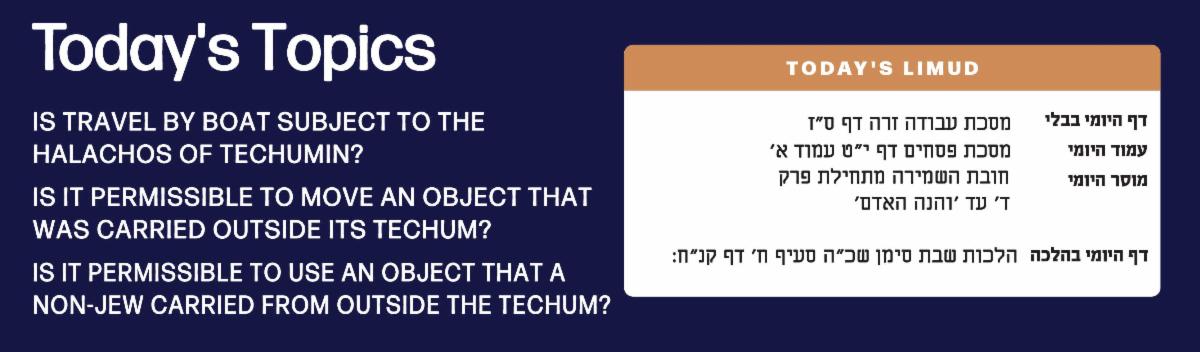
Is travel by boat subject to the halachos of techumin?

It is forbidden mid'rabonon to walk more than two thousand amos past the place where one settled at the onset of Shabbos. The area within which walking is permitted is known as the techum Shabbos. Poskim offer different views regarding the actual length (in feet) of two thousand amos. The range is anywhere from 2992- 3779 feet. According to some Rishonim, walking more than 12 mil (approximately 6-8 miles) is forbidden min haTorah.  The Gemara questions whether an area higher than ten tefachim (approximately 35-40 inches) is included in the halachos of techumin. The issue is relevant to those who wish to travel over two thousand amos in a boat that is more than ten tefachim from the bottom of the sea. Practically, a person may be lenient as long as the boat was higher than ten tefachim from the bottom of the sea at the onset of Shabbos.


[שו"ע שכה, ח; משנ"ב מא ו־מב; ביאורים ומוספים דרשו, 41; בהתאם לשו"ע תד, א, ומשנ"ב ג, ה ו־ז]

Is it permissible to move an object that was carried outside its techum?

An object that was carried outside its techum (i.e. more than two thousand amos from its location at the onset of Shabbos) may not be moved more than four amos (approximately 6-8 feet).  Even an object carried by a non-Jew past its techum may not be moved more than four amos. An item that was carried into a house, a courtyard or a city surrounded by an eiruv may be carried within the area where it was brought.


[שו"ע שכה, ח, משנ"ב מג-מה ; בהתאם לשו"ע שצז, ג, ו־תה, א ו־ו ; וראה שם שסב, י-יא, ו־שצו, א].

Is it permissible to use an object that a non-Jew carried from outside the techum?

It is forbidden to benefit from any melacha mid'rabonon performed by a non-Jew on a Jew's behalf on Shabbos. The prohibition extends into Motzei Shabbos up until kdei sheya'aseh -- the amount of time it takes to do the melacha – has passed. This prohibition applies to the person for whom the melacha was done. It also extends to his immediate family and steady guests. According to some opinions, it also applies to occasional guests, although they are permitted to benefit immediately after Shabbos. A person who was not the intended beneficiary of the forbidden labor (and is also not a family member or guest) may benefit from it on Shabbos. This is not the case when it comes to melachos min haTorah, however; no one can benefit from a non-Jew's action involving a melacha mid'oraisa. An item that a non-Jew carried from outside the techum is always classified as a rabbinic prohibition regarding these halachos, although it may have been brought from a distance of twelve mil (which some opinions hold is forbidden min haTorah). Two reasons are given to explain why techum has the leniencies of a rabbinic prohibition: 1) it is not explicit in the Torah, but rather only inferred from the pesukim, and 2) the prohibition of techum is subjective, since each person's boundaries are determined by where he was at the onset of Shabbos.


[שו"ע שכה, ח, משנ"ב לח, לט, מא ו־מב, ושעה"צ מג ו־מה; ביאורים ומוספים דרשו, 39-40]

YESTERDAY'S HIGHLIGHTS

  • It is forbidden to benefit from any melacha min haTorah that a non-Jew performed on a Jew's behalf. This prohibition extends into Motzei Shabbos until kdei sheya'aseh --the amount of time it takes to do the melacha – has passed.


  • Contemporary poskim disagree about whether it is permissible to walk through a doorway if the key that unlocked the door was carried by a non-Jew in a reshus harabim.


  • Contemporary poskim also disagree about whether it is permissible to board a bus (immediately after Shabbos) that a non-practicing Jew drove on Shabbos


TOMORROW'S TOPICS

  • Can a Jew benefit from melacha that a non-Jew may have done on Shabbos?


  • Can one benefit from melacha done by a child?


  • Can one benefit from melacha done by a child to avoid his father's wrath?


PLEASE NOTE: The information in this email is for learning purposes only. Please review the Mishna Berura and Biurim U'Musafim before making a halachic decision. Hebrew words are occasionally transliterated to enable a smoother reading of the text. Common Ashkenazi pronunciation is generally used in these cases.


Daf HaYomi B'Halacha Shiur


Rav Asher Eisenberger

View on Shas Illuminated


Synopsis of Today's Halachos


Rabbi Yerachmiel Garfield

Listen/Download
View/Download Kinyan Chochma Schedule
View/Download Today's Limud

Daily Luach

Keep up with the daily limud schedule with our pocket size daily learning schedule for all Dirshu programs, including Daf HaYomi B'Halacha.

Download PDF

Weekly Review

Review the limud of the week with a quick overview of pertinent topics and sheilos.

View All

Dirshu International | 911 County Line Rd. Suite 205 | Lakewood, NJ 08701 US

Unsubscribe | Update Profile | Constant Contact Data Notice

Constant Contact

No comments: