| Remembering the Chofetz Chaim: A Life of Torah, Chesed, and Kedushah
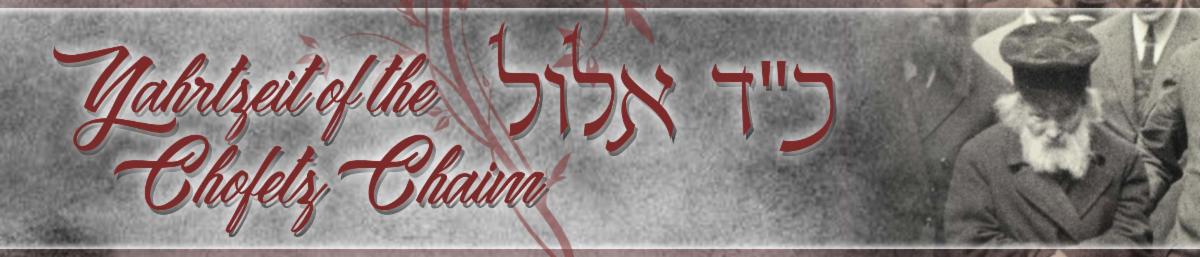
As the yahrtzeit of the holy Chofetz Chaim, Rav Yisrael Meir Hakohen Kagan zt"l, approaches (24 Elul), we reflect on the extraordinary legacy of a man whose impact on Torah, halacha, and middos tovos continues to shape Klal Yisrael today.
The Chofetz Chaim's nephew once discovered the siddur that had belonged to the Chofetz Chaim's mother. Upon seeing it, he held it tightly, kissed it, and wept. "You know what this siddur is?" he cried. "My mother davened from it every morning. These pages are soaked with the tears she shed for me to become an erlicher Yid. If I became anything in life, it is in the zechus of those tears." He could not part with that siddur.
In his early years, before he was well known, the Chofetz Chaim supported himself by tutoring young boys. He once remarked, "If someone has the skill to teach young children, it is very chashuv, even more than teaching older students, because you are building their foundation. At this stage, they are still moldable, and what you instill in them lasts forever."
After his marriage, he inherited 150 rubles, a large sum in those days. With this, he opened a store for his wife to manage while he continued learning, helping her for a few hours a day. Yet, his sensitivity to others shone even in business. Realizing that his store's honesty and integrity were drawing many customers and causing other stores to lose business, he made a decision: to close his store every day at chatzos. "I don't want to be competition to others," he explained. Such was the ehrlichkeit of the Chofetz Chaim, putting others before himself, even in parnassah.
Before establishing the famed Yeshiva of Radin, he was once appointed as a rosh yeshiva for an entire zman. He was paid 50 rubles for his work, which he planned to use for his family's parnassah. But on the way home, he heard of a yesomah whose shidduch was about to be broken because she couldn't come up with a dowry. Without hesitation, the Chofetz Chaim gave her all the money. When asked how he could do such a thing, he responded, "I can borrow money. No one will lend her—she has no way to pay it back.
His very first published sefer was Sefer Chofetz Chaim that he wrote at the age of 28. The next sefer he wrote was Machne Yisroel written specifically for Jewish soldiers drafted into the Czar's army, an environment hostile to Shabbos and kashrus. The sefer gave halachic guidance for minimizing chilul Shabbos and maintaining one's Yiddishkeit under pressure. This was the Chofetz Chaim's greatness: addressing the real needs of the tzibbur at the moment they needed it most.
Of course, his most famous work is the Mishnah Berurah, which took over 25 years to complete. Not because it required that much time, but because in between, he paused to write other seforim that Klal Yisrael needed, whether Ahavas Chesed, Sheim Olam, or Tiferes Yisrael. Each work was written in response to the spiritual needs of the generation.
When the Mishnah Berurah was finally published, the father of the Chazon Ish exclaimed, "Such a sefer can only be written with ruach hakodesh!" The Chazon Ish later explained: "When Hashem sees that someone dedicates themselves entirely to Torah, He grants them siyaata d'Shmaya beyond nature. That is the true definition of ruach hakodesh." A man came to a great Rav, utterly broken. He had suffered unbearable tragedy, child after child passed away. Desperate for help, he pleaded, "Rebbe, is there any segulah I can do to save the children I still have, and to be zocheh to healthy children in the future?"
The Rav responded with quiet conviction: "I don't know of any hidden segulos. But I do know what Chazal say. If you want rachamei Shamayim, be someone who brings rachamim into the world. There's no gemach in your town, open one. Help others. Be gomel chesed, and in that merit, Hashem will help you."
The man took those words to heart. He established a gemach and poured his energy into helping others with loans, support, and kindness. Slowly, things began to change. He had children, and this time they lived and thrived. His home was filled with joy and blessing. The gemach also flourished, expanding its reach and becoming an integral part of the community.
Years passed. The man aged, and he began to feel the burden. The gemach had grown, and he was ready to step aside. A committee now ran its operations, and he asked to resign. The members took a vote and he was voted out. He was relieved. He had served faithfully and was ready to rest.
But the very next night, tragedy struck. One of his children suddenly passed away. Devastated and frightened, the man ran back to the Rav and poured out his heart. "Please tell me what to do!"
The Rav's response was immediate: "Go back to the gemach. Even if you're no longer the official head, volunteer. Get involved again. That zechus is your yeshua." The man returned to the gemach and resumed his involvement, this time even more devoted than before.
At the time the story was told, no one knew who this Rav was. It was only much later that it came out: the Rav was none other than the Chofetz Chaim himself.
And yet, when the Chofetz Chaim told the story, he never revealed that it was about him. He recounted it simply as a lesson for others, with no hint of personal credit.
The Chazon Ish writes in Igros Chazon Ish (siman 41) that our Torah tradition from Sinai was passed down through three foundational halachic works: the Beis Yosef, the Magen Avraham, and the Chofetz Chaim. He writes that their psak halacha is like hearing it from the Sanhedrin in the Lishkas Hagazis, and one is not permitted to veer from their rulings.
The Chofetz Chaim was not just a posek hador, not just a tzaddik hador, he was the heart of the generation. His Torah, his chesed, his humility, his concern for every Jew, and his unwavering dedication to Hashem continue to light the way for us all.
As his yahrtzeit approaches, may we take upon ourselves to learn from his ways, whether in shemiras halashon, in acts of quiet chesed, or in honest selflessness and may we merit his intercession baShamayim for us and all of Klal Yisrael.
By: Rabbi Moshe Oelbaum
| 








No comments:
Post a Comment