| Sugya D'Kallah Overview Click here to download
One of the defining features of the AIA Yarchei Kallah is its structured program of hachanah. Over the past two decades, we have consistently seen that the more yegiah that participants invest in preparing the sugyos beforehand, the more meaningful and enduring their limud becomes. Despite the many Torah responsibilities that our participants already carry, a remarkable number devote significant time to advance study, an investment that yields extraordinary dividends. Coming prepared to a shiur from Rav Dovid Cohen, Rav Issamar Garbuz, or Rav Nissan Kaplan transforms the entire experience. The geshmak in learning and the clarity achieved through prior preparation are immeasurable.
With the help of Zoom, lomdim have been able to engage in pre-program learning and discussion, building lasting relationships with maggidei shiur and fellow participants. Our goal is to maintain, and further expand, what has effectively become a four-month pre-Yarchei Kallah yeshiva. To date, this initiative has produced thousands of hours of limud b'iyun, and we look forward to continuing this avodas hakodesh in the months ahead.
Overview of the Sugyos
This year's sugya, "אם כסף תלוה :מצות הלוואה"—the mitzvah of lending—encompasses many complex subtopics. While we will not be able to cover every detail, we have identified several core areas that will provide participants with a deep understanding of both the yesodos and the pratim of the halachos.
A. The Mitzvah to Lend Money
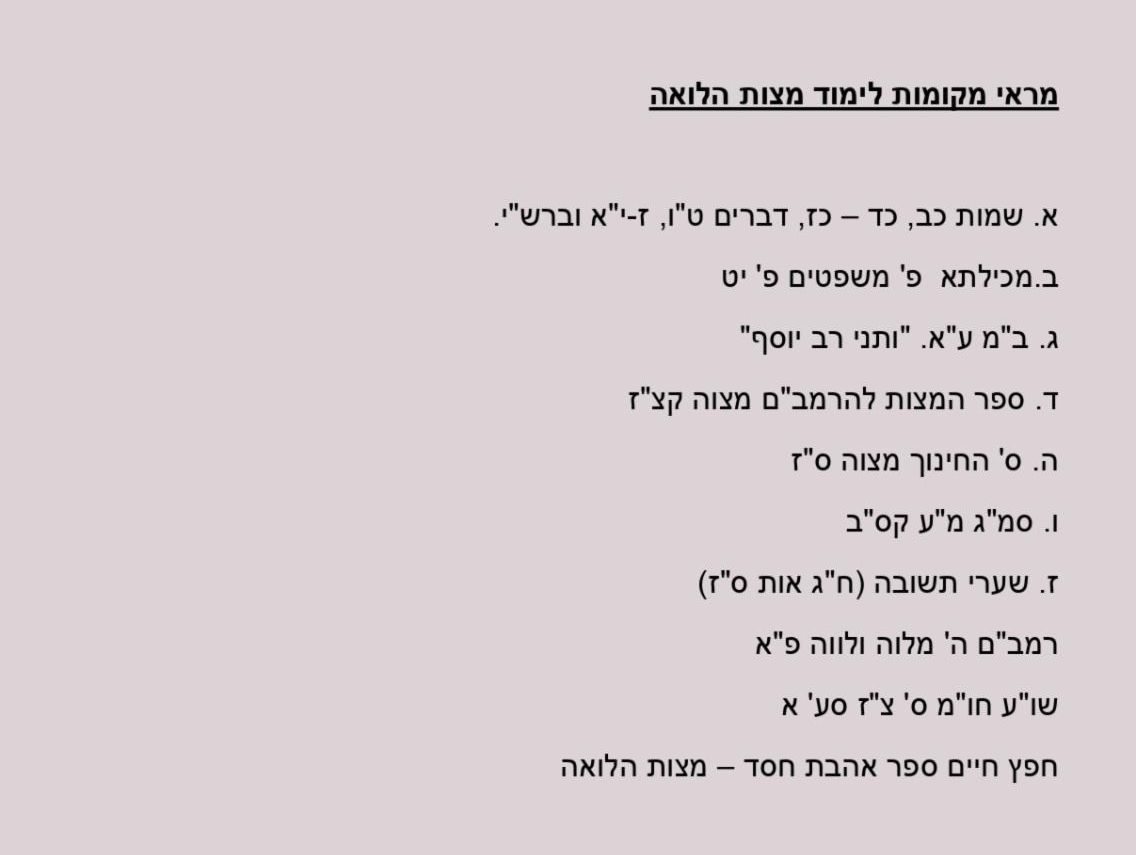
We will explore the yesod of this mitzvah and its sources in Chazal, both Shas and Medrashei halacha. The major shitos of the Rishonim, including the Rambam, Sefer HaChinuch, Sefer Mitzvos Gadol, and Rabbeinu Yonah, will be examined, along with the poskim—the Tur, Shulchan Aruch, and their commentaries.
The Acharonim have written extensively on this subject, particularly the Chofetz Chaim in Sefer Ahavas Chesed, which will serve as a central reference. Among the questions to be studied:
- To whom does the obligation to lend apply (including lending to the wealthy)?
- The relationship between lending and tzedakah, and which takes precedence.
- The duty to lend even when it may entail financial loss (chayecha kodmim considerations).
- The heter iska and its place within this mitzvah.
- Related issues such as store credit, non-monetary loans, and gemachim.
While ribbis will not be the main focus, its intersection with halva'ah will be noted.
B. Loans and Collections
We will delve into the issur of "Lo sihyeh lo k'nosheh," which governs the lender's behavior toward the borrower, including taking a mashkon, entering the borrower's home, and avoiding coercive collection tactics. Additional discussions will include:
- The permissibility of requesting repayment when uncertain of the borrower's means.
- Whether a lender may require the borrower to work to repay.
- The concept of mesadrin l'baal chov (arranging payment terms).
- The modern definition of assets in halachic terms.
- How these principles interact with priyas baal chov mitzvah.
C. The Role of the ערב (Guarantor)
This section will explore the lomdus behind the concept of ערבות, focusing on sugyos in Kiddushin and Bava Basra. We will analyze:
- Whether a kinyan is required and why ערבות is not considered an asmachta.
- Various classifications of ערב and their obligations.
- The shitos of Rishonim and Acharonim regarding acceptance of liability.
- The implications if the lender did not rely on the ערב.
- Potential issues of mazik and shlichus in assuming responsibility.
- Practical applications in modern finance, such as title insurance, corporate guarantees, and mortgage arrangements.
D. Forgiveness and Bankruptcy
We will study the halachic frameworks that dissolve debt, including shemittas kesafim, yei'ush, and mechilah. Each has distinct implications for both lender and borrower.
The modern issue of bankruptcy in halacha will be analyzed through the lens of contemporary poskim, considering how secular financial systems align—or conflict—with Torah law.
While the scope of this sugya is vast, we will, as always, strive to present it in an accessible, organized, and engaging manner, ensuring that every participant gains clarity, lomdus, and simchas haTorah at their own level.
Rabbi Shlomo Gottesman | 

No comments:
Post a Comment